https://www.bing.com/search?q=eric++berne%2C+in+games+people+play%2C+differentiate+between+ulterior+transaction%2C+concealed+motives%2C+and+hidden+agenda
https://blog.practicaljournal.com/articles/unmasking-the-psychological-games-we-play-insights-from-eric-bernes-games-people-play
https://ericberne.com/transactional-analysis/
https://ericberne.com/games-people-play/
https://ericberne.com/games-people-play/
Dr. Thomas A. Harris, author of I’m OK, You’re OK, and
Claude Steiner, author of Scripts People Live.
to many others, the ideas presented within Games People Play provided a deeper understanding of their own social interactions as well as their motives in these transactions. One reader wrote:
“Many times in my life, I was placed in social situations that left me feeling so depleted afterwards and I could not exactly grasp why this was happening. When I read Games People Play, I started to understand how many people play these games that end up making me feel used and hopeless. After a year or so, I also began realizing that I play some of these games myself… This is when I really decided to change my life. I began living with a new awareness of the behaviors of not only others but my own as well!”
millions of individuals and couples across the world have used Berne’s techniques to unlock the mysteries of their relationships.
What are the games in Games People Play?
Berne defined games as:
“A game is an ongoing series of complementary ulterior transactions progressing to a well-defined, predictable outcome. Descriptively, it is a recurring set of transactions… with a concealed motivation… or gimmick.”
To re-state Berne’s definition, one can think of a game as a series of interactions (words, body language, facial expressions, etc.) between two or more people that follow a predictable pattern. The interactions ultimately progress to an outcome in which one individual obtains a “payoff” or “goal.” In most cases, the participants of the games are unaware that they are “playing.”
https://ericberne.com/games-people-play/
Dr. James Allen on the Impact of Games People Play
https://ericberne.com/dr-james-allen-on-the-impact-of-games-people-play/
On a cold winter Quebec morning 40 years ago, my supervisor gave me a copy of Games People Play (Berne, 1964), remarking that, despite the book’s strange title, its author had given psychiatry the wheel. I was a first-year psychiatry resident at McGill University at the time, and my supervisor, Heinz Lehman, M.D., was then arguably the most influential psychiatrist in North America.
And so, after many years, I read the book once again, and once again I was struck by the usefulness of Berne’s intuitive hunches and the acumen of his clinical observations. It is as if suddenly a new door swings open before us.
Berne expected game analysis to be improved as further knowledge accumulated, but he laid out the elements: thesis, aim, roles, transactions, paradigm, moves, six types of advantages, and payoff. He was not always clear about the differences between games, pastimes, and scripts in 1964,
One of the most important things about this seminal book, however, was that it gave members of the public a sense that they and others could be understood—and, more importantly, that they could change. Today we could describe this as providing permissions and tools to enhance their psychological mindedness and to increase their experiences of positive emotions.
For example, although not used in Games People Play, the term “trading stamps” is still a useful metaphor for feelings that are collected, treasured, and then turned in for script “prizes.” “Sweatshirts” gives a memorable picture of people who reinforce two existential positions: A person may wear the slogan “Please love me” on the front and “Not you, stupid” on the back. “Streetcar” is a useful way of describing people who travel together but get off at different (script) stops. All these terms give a piercing glimpse of what is, and they do so in the basic tradition of transactional analysis.
The Script newsletter
REFERENCES
Berne, E. (1964). Games people play: The psychology of human relationships. New York: Grove Press.
Berne, E. (1972). What do you say after you say hello?: The psychology of human destiny. New York: Grove Press.
Bollas, C. (1987). Extractive introjection. In C. Bollas, The shadow of the object: Psychoanalysis of the unthought known (pp. 157-173). New York: Columbia University Press. (Original work published 1984)
English, F. (1977). Racket and racketeering as the root of games. In R. N. Blakeney (Ed.), Current issues in transactional analysis: The first international transactional analysis association European conference. New York: Brunner/Mazel.
Erskine, R. G., & Zalcman, M. J. (1979). The racket system: A model for racket analysis. Transactional Analysis Journal, 9, 51-59.
Karpman, S. B. (1968). Fairy tales and script drama analysis. Transactional Analysis Bulletin, 26(1), 39-43.
Goulding, M. M., & Goulding, R. L. (1979). Changing lives through redecision therapy. New York: Grove Press.
Schiff, J. L., with Schiff, A. W., Mellor, K., Schiff, E., Schiff, S., Richman, D., Fishman, J., Wolz, L., Fishman, C., & Momb, D. (1975). Cathexis reader: Transactional analysis treatment of psychosis. New York: Harper & Row.
Sills, C. (2003). Role lock: When the whole group plays a game. Transactional Analysis Journal, 33, 282-287.
https://ericberne.com/dr-james-allen-on-the-impact-of-games-people-play/
New York Times Essay on Self Help Books
The following essay appeared in the New York Times on Sunday June 20, 2004. The thrust of this piece is to describe the two “first” pop-psychology books published, Games People Play and then I’m OK – You’re OK and then to argue that their modern counterparts lack the depth and complexity that these classics possess.
THE LAST WORD; The Golden Age of Self-Help
By LAURA MILLER
https://ericberne.com/new-york-times-essay-on-self-help-books/
The following is from the New York Times, dated July 17 1966. It was written by Jack Languth. This article was published nearly 2 years after the release of Games People Play, when Dr. Berne was achieving widespread attention for his groundbreaking book. Article is copyright The New York Times.
https://ericberne.com/dr-berne-plays-the-celebrity-game/
– Jack Languth, The New York Times, July 17, 1966.
Despite his casual names for transactions, they must meet rigid qualifications before Dr. Berne will accept them as true games. He insists on locating a con, a gimmick and a payoff. If, for example, a woman courts a compliment and receives it gradually, she has only indulged in a social pastime. But if she asked for reassurance, received it, and then tried to show that the compliment was undeserved, she’s played “Yes, But.” Her pay-off was not the simple massaging of her vanity but the chance to prove her partner stupid and feel superior at his expense.
In the last few months, Dr. Berne has come to believe that games are always harmful because they involve deep emotional deception – the con. To keep his games theory unmuddled, the doctor would now remove all harmless “games” from his book and label them mere “pastimes.” The pastime, like the one he calls “Homely Sage,” does not rest on ulterior motives. The sage acquires odd bits of learning during his business career in a big city. When he retires to a small town, he offers this knowledge unassumingly to his new neighbors. In the “Games People Play” book, the sage was playing a good game. Now that the doctor has decided that all games, by definition, are destructive, the sage is held to be only passing time.
“Con” and “gimmick” like “shrink” for “analyst,” are words instantly adopted by Dr. Berne because they’re short. In his guide for group therapists Dr. Berne demands that young shrinks “try to say it in Anglo-Saxon words of no more than two syllables.”
He offers this contrast: A Freudian might say, “Oh, yes, another paranoid 30-year old unmarried woman secretary with no siblings and a strict father.” The Transactional Analyst would say, “Oh, yes, a secretive ‘Ain’t it Awful’ player who always looks tearful so what people won’t ask her too many questions and who is continually threatening to quit her job.
psychiatric resident came to him a few weeks ago for advice on setting up a therapy group; the young man spouted case histories and long words. Dr. Berne cut in, “Why do you want this group? What are you personally going to get out if it?”
The resident’s baby face fell into a fat grin: “It’ll be fun.”
The answer did not distress Dr. Berne, who preaches laughter and even practices it. “If I have a concept of God,” he has said, “the main thing is that He has a sense of humor.”
“We want patients to hear the birds sing,” he can say, making it sound like a duty other people are shirking. “We encourage that kind of childlike awareness. Patients who really do hear the birds and see the trees get very excited.”
It was a little boy, back in 1954, who taught Dr. Berne the central truth of Transactional Analysis. Or, more precisely, it was a successful middle-aged lawyer who said during a therapy session, “I’m not really a lawyer. I’m just a little boy.”
Rather than preserve the impassive silence, Dr. Berne said, “That’s interesting. Tell me more.”
From that time on he would ask the patient: “Is that the man talking, or the little boy you told me about?”
He’s found that only one of his fellow members, an Austrian, can write articles that don’t need translation from psychiatric polysyllables into plain English. He also permits no article to run more than two pages because “it looks tidier that way.” (“He’s really very anal,” one devotee says of Dr. Berne, “but don’t tell him I used a Freudian term.”)
“We don’t want patients to make progress,” he often says. “We want them to get well. Or, in our lingo, we want to turn frogs into princes. We’re not satisfied with making them braver frogs.”
Most of the 75-cent royalty he gets from each book goes to the Internal Revenue Service.
One young woman tells of her first private session with him before joining a therapy group. “I was determined not to hold anything back, although it’s very difficult for me to talk about intimate things. Still, I tell him everything I thought he should know about me – my childhood, my marriage, my sex life.”
“When I got all done and was really exhausted, he looked up and said, ‘Would you take off your dark glasses and tell me that all over again?'”
Inspecting the custom-made sports car of a one of his younger colleagues, Dr. Berne observed, “Your patients will start getting well when you get a car with handles that open as easily from the inside as they do from the outside.”
More recently, he described the Adult as a computer making rational decisions based on realistic alternatives.
When his Adult is in command, Dr. Berne offers this sermon on life: “Life is really very simple. But if people have to face that fact they get very upset. So the invent religions and pastimes and games. These are the same people who then lament how awful it is that life is complicated. But all complications involve decisions, and a person must assess the probabilities and possibilities, make the best decision and then go down the street whistling.”
“I’m a 56 year-old teenager” or “I’m sort of a swinger. I like action.”
“The Kuzzilbash,” a three volume swashbuckler about 18th-century Persia.
“When we really want to put someone down,” he told a visitor as they walked through Carmel, “we call this town Carmel-by-the-Sea.”
“I saw Nixon on TV and his Child was showing.”
“Davy” in his text should have been called “Eric.”
“Lennard Gandalac” and “Ramsbottom Horsely.” Why “Grandala”?
“Is that a secret I have to tell?” the doctor asks. “Well, the name comes from old French epics. He was a sort of a hero. A big man, physically. A giant, I guess.”
Later he wrote as “Peter Pinto.”
“Cyprian St. Cyr.”
A word Dr. Berne often uses is “permission.” If a man fails in every job, his Parent is not giving him permission to succeed. The therapist must then trace the reasons and help him to see that he has every right to do a job well and reap the rewards.
“I have very little sympathy for artists who can’t work while they’re creating – the ones who let their children starve in order to finish a book.”
he cuts off and discussion by pointing out that it’s one thing to have a few insights and another to build a consistent theory. To illustrate, he borrows a metaphor from Freud: “Flirting is different from marriage.”
– Jack Languth, The New York Times, July 17, 1966.
https://ericberne.com/dr-berne-plays-the-celebrity-game/
https://ericberne.com/the-happy-valley/
https://ericberne.com/review-happy-valley/
https://www.amazon.com/gp/product/0394475623/
https://ericberne.com/beyond-games-and-scripts/
https://ericberne.com/games-people-play/debtor/
https://ericberne.com/what-do-you-say-after-you-say-hello/
https://underconsumed.medium.com/games-people-play-1964-eric-berne-2724ac26258f
Games People Play (1964) Eric Berne
Underconsumed Knowledge
·
4 min read
·
Jan 31, 2023
The seminal work of “Transactional Analysis”
Berne concludes that the path taken by most people in life is avoiding awareness, spontaneity, and intimacy by playing games. Intimacy is when instinctual programming overtakes social programming and restrictions/ulterior motives. It is the only cure for stimulus-hunger, recognition-hunger, and structure hunger (the need to avoid boredom). Games can be played amongst people, and involve transactions between the different roles within the different people: their inner “Parent,” “Adult,” and “Child.” The Child is intuitive, creative, spontaneous, and can enjoy; Adults are necessary for survival, process data, and compute probabilities for dealing with life; Parents free Adults to make better use of their decision skills by imparting a “That’s the way it’s done.” People are taught from a young age how to behave in society, as is necessary for their survival. Games get passed down from parents to children, thus forming cultural habits of a group of people. Not all social interactions are games; some are purely transactional. It may be hard to parse out what is a game, and what is a genuine interaction (a bank robber who wants to play “cops and robbers” as an inner “Child” vs. someone who is robbing a bank because they need money). Many people do things with other intentions thinly (or not so thinly) veiled underneath; they may or may not be aware of the reason driving their actions. When someone is being an adult, and is talking to another adult, no games are being played, and this is the best way to carry forward with an interaction — that is, honestly. People play games to extract “strokes” to the ego (“recognition hunger”) which are necessary to their psychological survival, which are inhibited by social rules and internal rules (programming) preventing their free expression. Any social intercourse has a biological advantage over no intercourse; thus, games are played, and they structure a lot of humanity’s time. If someone’s inner Child comes out in response to an Adult question, the ability to move towards a productive outcome is hindered. Rituals (parentally patterned) and procedures (adult patterned) both typically follow predetermined courses. People become acquaintances due to similar pastimes (drinking, complaining about husbands). A “position” is a statement which influences all of a person’s transactions, thus confirming their “role;” positions are taken and fixed early in life, before the individual is able to make such a commitment. Most people spend their life dealing with their position. In the game of “if it weren’t for him,” telling someone to “go ahead” instead of saying “don’t you dare” causes the game to break down, and someone’s perhaps unconscious reason for not actually wanting to do that thing is exposed; depriving people of games can plunge them into despair. Children play to people’s need for structure hunger (avoiding boredom). “Game free intimacy” is the perfect form of human living. Alcoholics are not psychologically cured if they cannot take a drink without descending into drunkenness; thus, Alcoholics Anonymous is a continuance of their game of being an alcoholic in need of rescue; he is afraid of intimacy. Once someone achieves something, a grand goal, their purpose as they perceive it is gone, and they can become aimless. The game of “why does this always happen to me” happens because you keep setting yourself up for it. The game of “Lunch Bag” gives the husband who brings a bag lunch complete control over the family finances; how would the wife dare spend money frivolously now (this book written nearly 60 years ago). People can play Parental games where they chose the premise; “Real men drive stick shift.” Many games are not played for their purpose on the surface, but rather, to provide reassurance to someone’s inner child that they are doing okay (“Why don’t you do solution X” “Yes, I would, but”). For social workers or some (bad) therapists, the prospect of success is alarming to the inner Parent because then their position is threatened; thus, there can exist an implicit agreement of continuing the tap-dance of helping someone who is not really attempting to get better, but just wants to be “helped” ongoing. People love a “wooden leg” that can provide them with an excuse why they cannot do something; “A literate player has no difficulty in finding authorities to support him.” Some games can be productive, such as the person who performs the good deed with an ulterior motive; to show others how great they are, they perform charity work. It is a game when someone is more interested in the effects on others than in the success or outcome itself. “In order to get away from the ennui of pastimes without exposing themselves to the dangers of intimacy, most people compromise for games.” People tend to pick others as friends who play the same games. A project is a decision; a resolution is a game. Someone who is preoccupied with being on time is dead inside, paying no attention to the world; someone who is preoccupied with collecting excuses is half dead inside, paying attention to the world to collect such excuses; only the person who lives in the now is aware and “alive.” “The aware person is alive because he knows how he feels, where he is and when it is. He knows that after he dies the trees will still be there, but he will not be there to look at them again, so he wants to see them now with as much poignancy as possible.” Spontaneity is liberation from the compulsion to play games and to feel feelings. Intimacy is the spontaneous, game-free candidness of an aware person, the Child living in the here and now, unspoiled by Parental influences, and is loving (the natural state of an infant).
Eric Berne
Transactional Analysis
Psychoanalysis
https://underconsumed.medium.com/games-people-play-1964-eric-berne-2724ac26258f
Games People Play Summary and Key Lessons
ByBooks That Slay Editors
Last Updated: September 18, 2023
https://booksthatslay.com/games-people-play-summary-and-key-lessons/
Quick Summary: The book focuses deep on the psychology that explores human social interactions as a series of psychological games. Berne identifies common behavioral patterns and strategies people employ in their relationships, shedding light on the hidden dynamics of human communication and conflict.
Full Summary
Introduction to Transactional Analysis
Berne starts by introducing the three ego states: Child, Adult, and Parent. These are not literal descriptions but are representative of our internal psychological states.
Child: The emotional, impulsive, and instinctual part of us.
Adult: The logical and analytical part of us.
Parent: The values, teachings, and behaviors we’ve absorbed from our parents and other authority figures.
Each game is described with its purpose or “payoff.” This is what participants subconsciously seek to gain from the game.
Catalog of Games
Berne provides a catalog of various games, categorized based on their degree of severity: First-degree (social ritual), Second-degree (games played in private), and Third-degree (life-threatening).
Life Scripts
Berne introduces the concept of life scripts, which are unconscious life plans that determine our feelings, choices, and actions. These scripts, often decided in childhood, can lead us to repeatedly play out certain games in our lives.
https://booksthatslay.com/wp-content/uploads/2023/09/image-49-1024x1536.png
https://blog.practicaljournal.com/articles/unmasking-the-psychological-games-we-play-insights-from-eric-bernes-games-people-play
https://ericberne.com/transactional-analysis/
https://ericberne.com/games-people-play/
https://ericberne.com/games-people-play/
Dr. Thomas A. Harris, author of I’m OK, You’re OK, and
Claude Steiner, author of Scripts People Live.
to many others, the ideas presented within Games People Play provided a deeper understanding of their own social interactions as well as their motives in these transactions. One reader wrote:
“Many times in my life, I was placed in social situations that left me feeling so depleted afterwards and I could not exactly grasp why this was happening. When I read Games People Play, I started to understand how many people play these games that end up making me feel used and hopeless. After a year or so, I also began realizing that I play some of these games myself… This is when I really decided to change my life. I began living with a new awareness of the behaviors of not only others but my own as well!”
millions of individuals and couples across the world have used Berne’s techniques to unlock the mysteries of their relationships.
What are the games in Games People Play?
Berne defined games as:
“A game is an ongoing series of complementary ulterior transactions progressing to a well-defined, predictable outcome. Descriptively, it is a recurring set of transactions… with a concealed motivation… or gimmick.”
To re-state Berne’s definition, one can think of a game as a series of interactions (words, body language, facial expressions, etc.) between two or more people that follow a predictable pattern. The interactions ultimately progress to an outcome in which one individual obtains a “payoff” or “goal.” In most cases, the participants of the games are unaware that they are “playing.”
https://ericberne.com/games-people-play/
Dr. James Allen on the Impact of Games People Play
https://ericberne.com/dr-james-allen-on-the-impact-of-games-people-play/
On a cold winter Quebec morning 40 years ago, my supervisor gave me a copy of Games People Play (Berne, 1964), remarking that, despite the book’s strange title, its author had given psychiatry the wheel. I was a first-year psychiatry resident at McGill University at the time, and my supervisor, Heinz Lehman, M.D., was then arguably the most influential psychiatrist in North America.
And so, after many years, I read the book once again, and once again I was struck by the usefulness of Berne’s intuitive hunches and the acumen of his clinical observations. It is as if suddenly a new door swings open before us.
Berne expected game analysis to be improved as further knowledge accumulated, but he laid out the elements: thesis, aim, roles, transactions, paradigm, moves, six types of advantages, and payoff. He was not always clear about the differences between games, pastimes, and scripts in 1964,
One of the most important things about this seminal book, however, was that it gave members of the public a sense that they and others could be understood—and, more importantly, that they could change. Today we could describe this as providing permissions and tools to enhance their psychological mindedness and to increase their experiences of positive emotions.
For example, although not used in Games People Play, the term “trading stamps” is still a useful metaphor for feelings that are collected, treasured, and then turned in for script “prizes.” “Sweatshirts” gives a memorable picture of people who reinforce two existential positions: A person may wear the slogan “Please love me” on the front and “Not you, stupid” on the back. “Streetcar” is a useful way of describing people who travel together but get off at different (script) stops. All these terms give a piercing glimpse of what is, and they do so in the basic tradition of transactional analysis.
The Script newsletter
REFERENCES
Berne, E. (1964). Games people play: The psychology of human relationships. New York: Grove Press.
Berne, E. (1972). What do you say after you say hello?: The psychology of human destiny. New York: Grove Press.
Bollas, C. (1987). Extractive introjection. In C. Bollas, The shadow of the object: Psychoanalysis of the unthought known (pp. 157-173). New York: Columbia University Press. (Original work published 1984)
English, F. (1977). Racket and racketeering as the root of games. In R. N. Blakeney (Ed.), Current issues in transactional analysis: The first international transactional analysis association European conference. New York: Brunner/Mazel.
Erskine, R. G., & Zalcman, M. J. (1979). The racket system: A model for racket analysis. Transactional Analysis Journal, 9, 51-59.
Karpman, S. B. (1968). Fairy tales and script drama analysis. Transactional Analysis Bulletin, 26(1), 39-43.
Goulding, M. M., & Goulding, R. L. (1979). Changing lives through redecision therapy. New York: Grove Press.
Schiff, J. L., with Schiff, A. W., Mellor, K., Schiff, E., Schiff, S., Richman, D., Fishman, J., Wolz, L., Fishman, C., & Momb, D. (1975). Cathexis reader: Transactional analysis treatment of psychosis. New York: Harper & Row.
Sills, C. (2003). Role lock: When the whole group plays a game. Transactional Analysis Journal, 33, 282-287.
https://ericberne.com/dr-james-allen-on-the-impact-of-games-people-play/
New York Times Essay on Self Help Books
The following essay appeared in the New York Times on Sunday June 20, 2004. The thrust of this piece is to describe the two “first” pop-psychology books published, Games People Play and then I’m OK – You’re OK and then to argue that their modern counterparts lack the depth and complexity that these classics possess.
THE LAST WORD; The Golden Age of Self-Help
By LAURA MILLER
https://ericberne.com/new-york-times-essay-on-self-help-books/
The following is from the New York Times, dated July 17 1966. It was written by Jack Languth. This article was published nearly 2 years after the release of Games People Play, when Dr. Berne was achieving widespread attention for his groundbreaking book. Article is copyright The New York Times.
https://ericberne.com/dr-berne-plays-the-celebrity-game/
– Jack Languth, The New York Times, July 17, 1966.
Despite his casual names for transactions, they must meet rigid qualifications before Dr. Berne will accept them as true games. He insists on locating a con, a gimmick and a payoff. If, for example, a woman courts a compliment and receives it gradually, she has only indulged in a social pastime. But if she asked for reassurance, received it, and then tried to show that the compliment was undeserved, she’s played “Yes, But.” Her pay-off was not the simple massaging of her vanity but the chance to prove her partner stupid and feel superior at his expense.
In the last few months, Dr. Berne has come to believe that games are always harmful because they involve deep emotional deception – the con. To keep his games theory unmuddled, the doctor would now remove all harmless “games” from his book and label them mere “pastimes.” The pastime, like the one he calls “Homely Sage,” does not rest on ulterior motives. The sage acquires odd bits of learning during his business career in a big city. When he retires to a small town, he offers this knowledge unassumingly to his new neighbors. In the “Games People Play” book, the sage was playing a good game. Now that the doctor has decided that all games, by definition, are destructive, the sage is held to be only passing time.
“Con” and “gimmick” like “shrink” for “analyst,” are words instantly adopted by Dr. Berne because they’re short. In his guide for group therapists Dr. Berne demands that young shrinks “try to say it in Anglo-Saxon words of no more than two syllables.”
He offers this contrast: A Freudian might say, “Oh, yes, another paranoid 30-year old unmarried woman secretary with no siblings and a strict father.” The Transactional Analyst would say, “Oh, yes, a secretive ‘Ain’t it Awful’ player who always looks tearful so what people won’t ask her too many questions and who is continually threatening to quit her job.
psychiatric resident came to him a few weeks ago for advice on setting up a therapy group; the young man spouted case histories and long words. Dr. Berne cut in, “Why do you want this group? What are you personally going to get out if it?”
The resident’s baby face fell into a fat grin: “It’ll be fun.”
The answer did not distress Dr. Berne, who preaches laughter and even practices it. “If I have a concept of God,” he has said, “the main thing is that He has a sense of humor.”
“We want patients to hear the birds sing,” he can say, making it sound like a duty other people are shirking. “We encourage that kind of childlike awareness. Patients who really do hear the birds and see the trees get very excited.”
It was a little boy, back in 1954, who taught Dr. Berne the central truth of Transactional Analysis. Or, more precisely, it was a successful middle-aged lawyer who said during a therapy session, “I’m not really a lawyer. I’m just a little boy.”
Rather than preserve the impassive silence, Dr. Berne said, “That’s interesting. Tell me more.”
From that time on he would ask the patient: “Is that the man talking, or the little boy you told me about?”
He’s found that only one of his fellow members, an Austrian, can write articles that don’t need translation from psychiatric polysyllables into plain English. He also permits no article to run more than two pages because “it looks tidier that way.” (“He’s really very anal,” one devotee says of Dr. Berne, “but don’t tell him I used a Freudian term.”)
“We don’t want patients to make progress,” he often says. “We want them to get well. Or, in our lingo, we want to turn frogs into princes. We’re not satisfied with making them braver frogs.”
Most of the 75-cent royalty he gets from each book goes to the Internal Revenue Service.
One young woman tells of her first private session with him before joining a therapy group. “I was determined not to hold anything back, although it’s very difficult for me to talk about intimate things. Still, I tell him everything I thought he should know about me – my childhood, my marriage, my sex life.”
“When I got all done and was really exhausted, he looked up and said, ‘Would you take off your dark glasses and tell me that all over again?'”
Inspecting the custom-made sports car of a one of his younger colleagues, Dr. Berne observed, “Your patients will start getting well when you get a car with handles that open as easily from the inside as they do from the outside.”
More recently, he described the Adult as a computer making rational decisions based on realistic alternatives.
When his Adult is in command, Dr. Berne offers this sermon on life: “Life is really very simple. But if people have to face that fact they get very upset. So the invent religions and pastimes and games. These are the same people who then lament how awful it is that life is complicated. But all complications involve decisions, and a person must assess the probabilities and possibilities, make the best decision and then go down the street whistling.”
“I’m a 56 year-old teenager” or “I’m sort of a swinger. I like action.”
“The Kuzzilbash,” a three volume swashbuckler about 18th-century Persia.
“When we really want to put someone down,” he told a visitor as they walked through Carmel, “we call this town Carmel-by-the-Sea.”
“I saw Nixon on TV and his Child was showing.”
“Davy” in his text should have been called “Eric.”
“Lennard Gandalac” and “Ramsbottom Horsely.” Why “Grandala”?
“Is that a secret I have to tell?” the doctor asks. “Well, the name comes from old French epics. He was a sort of a hero. A big man, physically. A giant, I guess.”
Later he wrote as “Peter Pinto.”
“Cyprian St. Cyr.”
A word Dr. Berne often uses is “permission.” If a man fails in every job, his Parent is not giving him permission to succeed. The therapist must then trace the reasons and help him to see that he has every right to do a job well and reap the rewards.
“I have very little sympathy for artists who can’t work while they’re creating – the ones who let their children starve in order to finish a book.”
he cuts off and discussion by pointing out that it’s one thing to have a few insights and another to build a consistent theory. To illustrate, he borrows a metaphor from Freud: “Flirting is different from marriage.”
– Jack Languth, The New York Times, July 17, 1966.
https://ericberne.com/dr-berne-plays-the-celebrity-game/
https://ericberne.com/the-happy-valley/
https://ericberne.com/review-happy-valley/
https://www.amazon.com/gp/product/0394475623/
https://ericberne.com/beyond-games-and-scripts/
https://ericberne.com/games-people-play/debtor/
https://ericberne.com/what-do-you-say-after-you-say-hello/
https://underconsumed.medium.com/games-people-play-1964-eric-berne-2724ac26258f
Games People Play (1964) Eric Berne
Underconsumed Knowledge
·
4 min read
·
Jan 31, 2023
The seminal work of “Transactional Analysis”
Berne concludes that the path taken by most people in life is avoiding awareness, spontaneity, and intimacy by playing games. Intimacy is when instinctual programming overtakes social programming and restrictions/ulterior motives. It is the only cure for stimulus-hunger, recognition-hunger, and structure hunger (the need to avoid boredom). Games can be played amongst people, and involve transactions between the different roles within the different people: their inner “Parent,” “Adult,” and “Child.” The Child is intuitive, creative, spontaneous, and can enjoy; Adults are necessary for survival, process data, and compute probabilities for dealing with life; Parents free Adults to make better use of their decision skills by imparting a “That’s the way it’s done.” People are taught from a young age how to behave in society, as is necessary for their survival. Games get passed down from parents to children, thus forming cultural habits of a group of people. Not all social interactions are games; some are purely transactional. It may be hard to parse out what is a game, and what is a genuine interaction (a bank robber who wants to play “cops and robbers” as an inner “Child” vs. someone who is robbing a bank because they need money). Many people do things with other intentions thinly (or not so thinly) veiled underneath; they may or may not be aware of the reason driving their actions. When someone is being an adult, and is talking to another adult, no games are being played, and this is the best way to carry forward with an interaction — that is, honestly. People play games to extract “strokes” to the ego (“recognition hunger”) which are necessary to their psychological survival, which are inhibited by social rules and internal rules (programming) preventing their free expression. Any social intercourse has a biological advantage over no intercourse; thus, games are played, and they structure a lot of humanity’s time. If someone’s inner Child comes out in response to an Adult question, the ability to move towards a productive outcome is hindered. Rituals (parentally patterned) and procedures (adult patterned) both typically follow predetermined courses. People become acquaintances due to similar pastimes (drinking, complaining about husbands). A “position” is a statement which influences all of a person’s transactions, thus confirming their “role;” positions are taken and fixed early in life, before the individual is able to make such a commitment. Most people spend their life dealing with their position. In the game of “if it weren’t for him,” telling someone to “go ahead” instead of saying “don’t you dare” causes the game to break down, and someone’s perhaps unconscious reason for not actually wanting to do that thing is exposed; depriving people of games can plunge them into despair. Children play to people’s need for structure hunger (avoiding boredom). “Game free intimacy” is the perfect form of human living. Alcoholics are not psychologically cured if they cannot take a drink without descending into drunkenness; thus, Alcoholics Anonymous is a continuance of their game of being an alcoholic in need of rescue; he is afraid of intimacy. Once someone achieves something, a grand goal, their purpose as they perceive it is gone, and they can become aimless. The game of “why does this always happen to me” happens because you keep setting yourself up for it. The game of “Lunch Bag” gives the husband who brings a bag lunch complete control over the family finances; how would the wife dare spend money frivolously now (this book written nearly 60 years ago). People can play Parental games where they chose the premise; “Real men drive stick shift.” Many games are not played for their purpose on the surface, but rather, to provide reassurance to someone’s inner child that they are doing okay (“Why don’t you do solution X” “Yes, I would, but”). For social workers or some (bad) therapists, the prospect of success is alarming to the inner Parent because then their position is threatened; thus, there can exist an implicit agreement of continuing the tap-dance of helping someone who is not really attempting to get better, but just wants to be “helped” ongoing. People love a “wooden leg” that can provide them with an excuse why they cannot do something; “A literate player has no difficulty in finding authorities to support him.” Some games can be productive, such as the person who performs the good deed with an ulterior motive; to show others how great they are, they perform charity work. It is a game when someone is more interested in the effects on others than in the success or outcome itself. “In order to get away from the ennui of pastimes without exposing themselves to the dangers of intimacy, most people compromise for games.” People tend to pick others as friends who play the same games. A project is a decision; a resolution is a game. Someone who is preoccupied with being on time is dead inside, paying no attention to the world; someone who is preoccupied with collecting excuses is half dead inside, paying attention to the world to collect such excuses; only the person who lives in the now is aware and “alive.” “The aware person is alive because he knows how he feels, where he is and when it is. He knows that after he dies the trees will still be there, but he will not be there to look at them again, so he wants to see them now with as much poignancy as possible.” Spontaneity is liberation from the compulsion to play games and to feel feelings. Intimacy is the spontaneous, game-free candidness of an aware person, the Child living in the here and now, unspoiled by Parental influences, and is loving (the natural state of an infant).
Eric Berne
Transactional Analysis
Psychoanalysis
https://underconsumed.medium.com/games-people-play-1964-eric-berne-2724ac26258f
Games People Play Summary and Key Lessons
ByBooks That Slay Editors
Last Updated: September 18, 2023
https://booksthatslay.com/games-people-play-summary-and-key-lessons/
Quick Summary: The book focuses deep on the psychology that explores human social interactions as a series of psychological games. Berne identifies common behavioral patterns and strategies people employ in their relationships, shedding light on the hidden dynamics of human communication and conflict.
Full Summary
Introduction to Transactional Analysis
Berne starts by introducing the three ego states: Child, Adult, and Parent. These are not literal descriptions but are representative of our internal psychological states.
Child: The emotional, impulsive, and instinctual part of us.
Adult: The logical and analytical part of us.
Parent: The values, teachings, and behaviors we’ve absorbed from our parents and other authority figures.
Each game is described with its purpose or “payoff.” This is what participants subconsciously seek to gain from the game.
Catalog of Games
Berne provides a catalog of various games, categorized based on their degree of severity: First-degree (social ritual), Second-degree (games played in private), and Third-degree (life-threatening).
Life Scripts
Berne introduces the concept of life scripts, which are unconscious life plans that determine our feelings, choices, and actions. These scripts, often decided in childhood, can lead us to repeatedly play out certain games in our lives.
https://booksthatslay.com/wp-content/uploads/2023/09/image-49-1024x1536.png
games people play (summarized in 5 points)
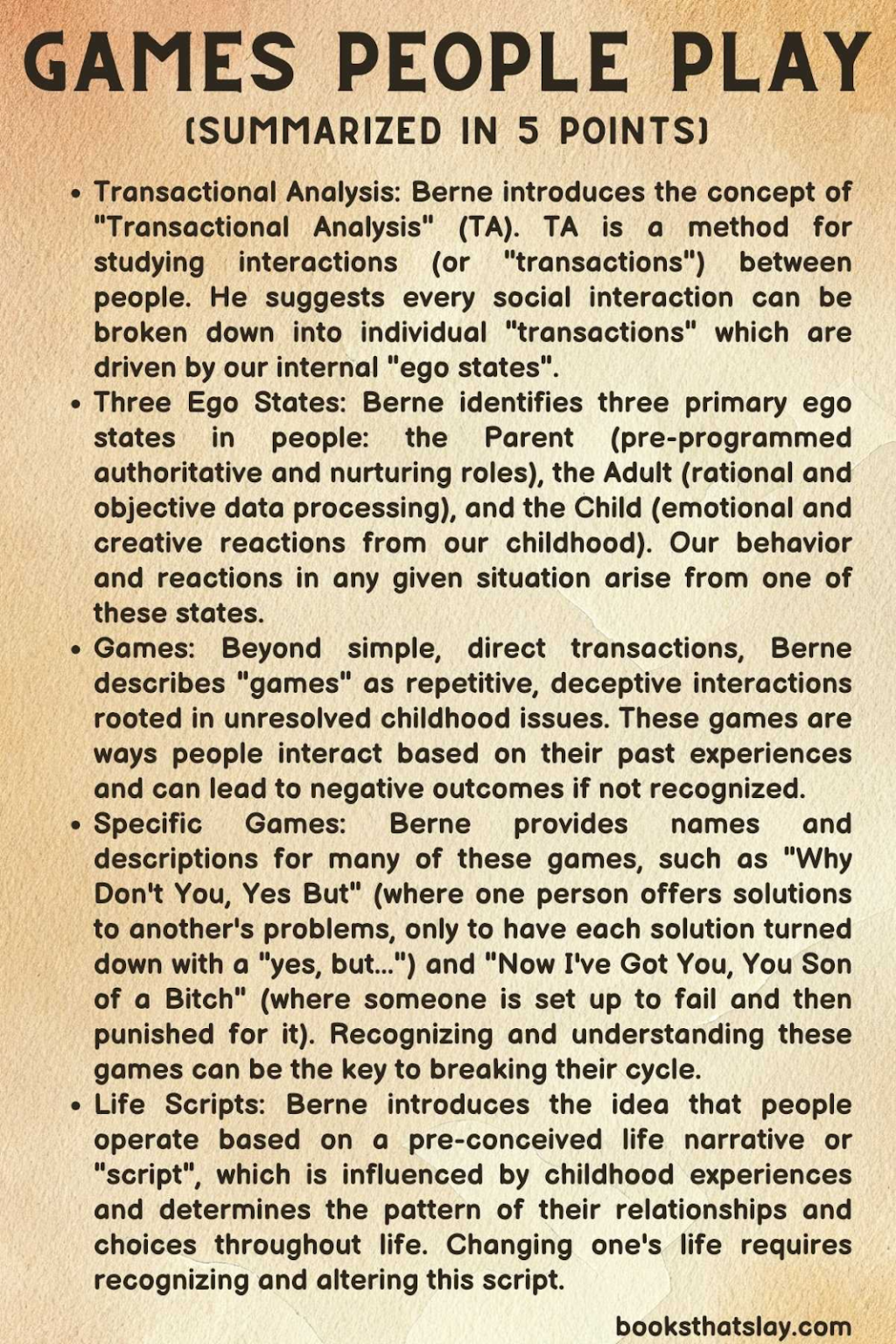
• transactional analysis: Berne introduces the concept of "Transactional analysis" (TA). TA is a method for studying interactions (or "transactions") between people. He suggests every social interaction can be broken down into individual "transactions" which are driven by our internal "ego states".
• three ego states: Berne identifies three primary ego states in people: the Parent (pre-programmed authoritative and nurturing roles), the Adult (rational and objective data processing), and the Child (emotional and creative reactions from our childhood). Our behavior and reactions in any given situation arise from one of these states.
• games: beyond simple, direct transactions, Berne describe "games" as repetitive, deceptive interactions rooted in unresolved childhood issues. These games are ways people interact based on their past experiences and can lead to negative outcomes if not recognized.
• specific games: Berne provides names and descriptions for many of these games, such as "Why don't you, yes but" (where one person offers solutions to another's problems, only to have set up to fail and then punished for it). Recognizing and understanding these games can be the key to breaking their cycle.
• life scripts: Berne introduces the idea that people operate based on a pre-conceived life narrative or "script", which is influenced by childhood experiences and determines the pattern of their relationships and choices throughout life. Changing one's life requires recognizing and altering this scripts.
https://booksthatslay.com/wp-content/uploads/2023/09/image-49-1024x1536.png
• transactional analysis: Berne introduces the concept of "Transactional analysis" (TA). TA is a method for studying interactions (or "transactions") between people. He suggests every social interaction can be broken down into individual "transactions" which are driven by our internal "ego states".
• three ego states: Berne identifies three primary ego states in people: the Parent (pre-programmed authoritative and nurturing roles), the Adult (rational and objective data processing), and the Child (emotional and creative reactions from our childhood). Our behavior and reactions in any given situation arise from one of these states.
• games: beyond simple, direct transactions, Berne describe "games" as repetitive, deceptive interactions rooted in unresolved childhood issues. These games are ways people interact based on their past experiences and can lead to negative outcomes if not recognized.
• specific games: Berne provides names and descriptions for many of these games, such as "Why don't you, yes but" (where one person offers solutions to another's problems, only to have set up to fail and then punished for it). Recognizing and understanding these games can be the key to breaking their cycle.
• life scripts: Berne introduces the idea that people operate based on a pre-conceived life narrative or "script", which is influenced by childhood experiences and determines the pattern of their relationships and choices throughout life. Changing one's life requires recognizing and altering this scripts.
https://booksthatslay.com/wp-content/uploads/2023/09/image-49-1024x1536.png
Key Lessons
1. Self-awareness Leads to Genuine Interactions
One of the foundational concepts of Berne’s book is that people often engage in scripted interactions or “games” that they’re largely unconscious of. These games, while sometimes seemingly innocent or routine, can often lead to conflict, misunderstandings, and unfulfilling relationships.
By recognizing the games one plays:
You become more self-aware, realizing the underlying motives or payoffs you’re seeking.
You can choose not to engage in these games, breaking repetitive cycles that might have plagued your relationships.
By understanding the games others play, you can empathize better, navigate conflicts more effectively, and establish boundaries when necessary.
Genuine interactions, devoid of games, lead to real intimacy where individuals communicate openly and honestly, forging deeper and more meaningful connections.
2. Early Life Influences Drive Adult Behavior
Berne’s concept of ego states and life scripts underscores the importance of early life experiences and teachings in shaping our adult behavior. Key takeaways from this are:
Our Parent ego state holds the beliefs, values, and directives we’ve absorbed from our parents and influential figures. Recognizing when we’re operating from this state can help us discern whether we’re acting out of genuine belief or merely replicating patterns from our upbringing.
Life scripts are narratives we’ve unconsciously adopted, often in childhood, about how our life should play out. This can lead to repetitive patterns in relationships, career choices, and more. By identifying our life script, we can challenge and rewrite parts of it to better align with our authentic desires and needs.
The Child ego state embodies our early emotional experiences. While it can be the source of creativity and spontaneity, it can also lead us to react impulsively or based on outdated emotional patterns. By becoming conscious of this, we can respond rather than react to situations.
Key aspects of this lesson are:
Recognizing a game is the first step to opting out of it. Once you see the pattern, you can choose a different, healthier response.
Authenticity in relationships comes from dropping these games and striving for real intimacy. This means engaging with others from the Adult ego state, which is rooted in the present and is responsive rather than reactive.
Personal freedom isn’t just about recognizing your own games but also understanding the games of others. This doesn’t mean you should manipulate or counter-manipulate, but rather approach situations with understanding and empathy, or set boundaries when needed.
Life can be richer, relationships can be more fulfilling, and personal growth can be accelerated when we make the conscious choice to move beyond repetitive, unproductive games.
Final Thoughts
In summary, “Games People Play” provides a unique and influential perspective on human interactions. It suggests that many of our day-to-day interactions are not spontaneous but are based on deep-seated patterns and games.
Recognizing and understanding these games can lead to healthier, more genuine relationships.
https://booksthatslay.com/games-people-play-summary-and-key-lessons/
https://booksthatslay.com/the-tao-te-ching-summary/
https://booksthatslay.com/wp-content/uploads/2023/09/image-48-1024x1536.png
https://booksthatslay.com/wp-content/uploads/2023/09/image-48-1024x1536.png
https://booksthatslay.com/the-tao-te-ching-summary/
https://leaderself.com/summary/games-people-play-eric-berne/
Games People Play by Eric Berne
Last updated: Jul 13, 2023
Summary of Games People Play by Eric Berne
Games People Play is a groundbreaking book written by Eric Berne, a psychiatrist and psychoanalyst. Published in 1964, the book explores the concept of social interactions as "games" that people play in their everyday lives. Berne argues that these games are a way for individuals to manipulate and control others, often without even realizing it.
Berne introduces the idea of the "transactional analysis," which is a method of analyzing social interactions and understanding the underlying motivations and dynamics at play. He explains that each game has three main components: the players, the roles they assume, and the payoff they seek.
The book delves into various types of games that people commonly engage in, such as "If It Weren't For You," where individuals blame others for their own problems, and "Why Don't You - Yes But," where individuals seek advice but reject any suggestions given to them. Berne provides detailed examples and case studies to illustrate these games and their psychological implications.
Berne also explores the concept of "life scripts," which are predetermined patterns of behavior that individuals adopt based on their early life experiences. He argues that these scripts influence the games people play and shape their interactions with others. By understanding and challenging these scripts, individuals can break free from destructive patterns and create healthier relationships.
The book emphasizes the importance of self-awareness and personal responsibility in overcoming these games. Berne encourages readers to recognize their own role in perpetuating these games and to strive for more authentic and genuine interactions with others.
In conclusion, Games People Play is a thought-provoking book that sheds light on the complex dynamics of social interactions. It offers valuable insights into the games people play and provides tools for individuals to navigate these games more effectively. By understanding the underlying motivations and patterns, readers can gain a deeper understanding of themselves and others, leading to more fulfilling and meaningful relationships.
1. The concept of "transactional analysis"
One of the key takeaways from Games People Play is the concept of "transactional analysis." Berne introduces this concept as a way to understand and analyze human interactions. He suggests that every interaction between individuals can be broken down into three ego states: Parent, Adult, and Child. The Parent ego state represents learned behaviors and attitudes from authority figures, the Adult ego state represents rational and logical thinking, and the Child ego state represents emotions and spontaneous reactions.
By understanding these ego states, individuals can gain insight into their own behavior and the behavior of others. This awareness allows for more effective communication and can help break negative patterns and games that people play in their relationships. Transactional analysis provides a framework for understanding the dynamics of human interactions and can be a valuable tool for personal growth and improving relationships.
2. The concept of "games"
Berne introduces the concept of "games" as a way to describe repetitive patterns of behavior that people engage in unconsciously. These games are often driven by hidden motivations and can lead to negative outcomes in relationships. Berne identifies several common games, such as "Why Don't You...Yes But," where individuals seek advice but reject any suggestions given to them, or "If It Weren't For You," where individuals blame others for their own problems.
Understanding these games can help individuals recognize when they are engaging in them and break free from these destructive patterns. By becoming aware of the underlying motivations and dynamics of these games, individuals can make more conscious choices and improve their relationships. Berne's exploration of games provides valuable insights into human behavior and offers a roadmap for personal growth and healthier interactions.
3. The impact of childhood experiences on adult behavior
Berne emphasizes the importance of childhood experiences in shaping adult behavior. He suggests that many of the patterns and games people engage in as adults can be traced back to their early experiences and interactions with caregivers. For example, individuals who grew up with critical or controlling parents may adopt a Parent ego state and engage in similar behaviors in their adult relationships.
By understanding the impact of childhood experiences, individuals can gain insight into their own behavior and work towards breaking negative patterns. This awareness can also foster empathy and understanding towards others, as it highlights the role of past experiences in shaping their behavior. Berne's exploration of the link between childhood experiences and adult behavior provides a valuable perspective on personal growth and relationship dynamics.
4. The role of social scripts in interactions
Berne introduces the concept of "social scripts" as a way to understand the predetermined roles and behaviors individuals adopt in social interactions. These scripts are learned through socialization and dictate how individuals should behave in different situations. For example, the script for a doctor-patient interaction may involve the doctor taking on a Parent ego state and the patient taking on a Child ego state.
Understanding social scripts can help individuals recognize when they are conforming to societal expectations and behaving in ways that may not align with their true selves. By breaking free from these scripts, individuals can engage in more authentic and fulfilling interactions. Berne's exploration of social scripts sheds light on the influence of societal norms on individual behavior and offers a path towards greater self-awareness and authenticity.
5. The power of recognition and validation
Berne highlights the importance of recognition and validation in human interactions. He suggests that individuals have a fundamental need to be seen, heard, and acknowledged by others. When this need is not met, individuals may engage in games and manipulative behaviors to seek validation.
By recognizing and validating others, individuals can create a more positive and supportive environment. This can lead to healthier relationships and a greater sense of fulfillment. Berne's emphasis on the power of recognition and validation serves as a reminder of the importance of empathy and active listening in our interactions with others.
6. The dangers of game-playing in relationships
Berne warns about the dangers of game-playing in relationships. He suggests that engaging in games can lead to a breakdown in communication, trust, and intimacy. Games often involve hidden agendas and manipulative tactics, which can erode the foundation of a healthy relationship.
By becoming aware of the games we play and the impact they have on our relationships, we can work towards breaking free from these destructive patterns. This requires open and honest communication, a willingness to confront our own behaviors, and a commitment to building authentic connections. Berne's exploration of the dangers of game-playing serves as a reminder of the importance of cultivating healthy and genuine relationships.
7. The role of self-awareness in personal growth
Berne emphasizes the importance of self-awareness in personal growth. He suggests that by understanding our own patterns, motivations, and ego states, we can make more conscious choices and break free from negative behaviors.
Self-awareness allows us to recognize when we are engaging in games, understand the underlying motivations behind our actions, and take responsibility for our own behavior. It also enables us to have a deeper understanding of others and approach relationships with empathy and compassion. Berne's emphasis on self-awareness highlights its transformative power in personal growth and relationship dynamics.
8. The potential for change and growth
One of the most empowering takeaways from Games People Play is the belief in the potential for change and growth. Berne suggests that by becoming aware of our patterns and games, we can break free from destructive behaviors and create healthier relationships.
While change may require effort and self-reflection, Berne's message is one of hope and possibility. By understanding the dynamics of human interactions and taking responsibility for our own behavior, we can cultivate more fulfilling relationships and lead more authentic lives. Berne's exploration of the potential for change and growth serves as a reminder that we have the power to shape our own destinies.
https://leaderself.com/summary/games-people-play-eric-berne/
https://booksthatslay.com/the-tao-te-ching-summary/
https://leaderself.com/summary/games-people-play-eric-berne/
Games People Play by Eric Berne
Last updated: Jul 13, 2023
Summary of Games People Play by Eric Berne
Games People Play is a groundbreaking book written by Eric Berne, a psychiatrist and psychoanalyst. Published in 1964, the book explores the concept of social interactions as "games" that people play in their everyday lives. Berne argues that these games are a way for individuals to manipulate and control others, often without even realizing it.
Berne introduces the idea of the "transactional analysis," which is a method of analyzing social interactions and understanding the underlying motivations and dynamics at play. He explains that each game has three main components: the players, the roles they assume, and the payoff they seek.
The book delves into various types of games that people commonly engage in, such as "If It Weren't For You," where individuals blame others for their own problems, and "Why Don't You - Yes But," where individuals seek advice but reject any suggestions given to them. Berne provides detailed examples and case studies to illustrate these games and their psychological implications.
Berne also explores the concept of "life scripts," which are predetermined patterns of behavior that individuals adopt based on their early life experiences. He argues that these scripts influence the games people play and shape their interactions with others. By understanding and challenging these scripts, individuals can break free from destructive patterns and create healthier relationships.
The book emphasizes the importance of self-awareness and personal responsibility in overcoming these games. Berne encourages readers to recognize their own role in perpetuating these games and to strive for more authentic and genuine interactions with others.
In conclusion, Games People Play is a thought-provoking book that sheds light on the complex dynamics of social interactions. It offers valuable insights into the games people play and provides tools for individuals to navigate these games more effectively. By understanding the underlying motivations and patterns, readers can gain a deeper understanding of themselves and others, leading to more fulfilling and meaningful relationships.
1. The concept of "transactional analysis"
One of the key takeaways from Games People Play is the concept of "transactional analysis." Berne introduces this concept as a way to understand and analyze human interactions. He suggests that every interaction between individuals can be broken down into three ego states: Parent, Adult, and Child. The Parent ego state represents learned behaviors and attitudes from authority figures, the Adult ego state represents rational and logical thinking, and the Child ego state represents emotions and spontaneous reactions.
By understanding these ego states, individuals can gain insight into their own behavior and the behavior of others. This awareness allows for more effective communication and can help break negative patterns and games that people play in their relationships. Transactional analysis provides a framework for understanding the dynamics of human interactions and can be a valuable tool for personal growth and improving relationships.
2. The concept of "games"
Berne introduces the concept of "games" as a way to describe repetitive patterns of behavior that people engage in unconsciously. These games are often driven by hidden motivations and can lead to negative outcomes in relationships. Berne identifies several common games, such as "Why Don't You...Yes But," where individuals seek advice but reject any suggestions given to them, or "If It Weren't For You," where individuals blame others for their own problems.
Understanding these games can help individuals recognize when they are engaging in them and break free from these destructive patterns. By becoming aware of the underlying motivations and dynamics of these games, individuals can make more conscious choices and improve their relationships. Berne's exploration of games provides valuable insights into human behavior and offers a roadmap for personal growth and healthier interactions.
3. The impact of childhood experiences on adult behavior
Berne emphasizes the importance of childhood experiences in shaping adult behavior. He suggests that many of the patterns and games people engage in as adults can be traced back to their early experiences and interactions with caregivers. For example, individuals who grew up with critical or controlling parents may adopt a Parent ego state and engage in similar behaviors in their adult relationships.
By understanding the impact of childhood experiences, individuals can gain insight into their own behavior and work towards breaking negative patterns. This awareness can also foster empathy and understanding towards others, as it highlights the role of past experiences in shaping their behavior. Berne's exploration of the link between childhood experiences and adult behavior provides a valuable perspective on personal growth and relationship dynamics.
4. The role of social scripts in interactions
Berne introduces the concept of "social scripts" as a way to understand the predetermined roles and behaviors individuals adopt in social interactions. These scripts are learned through socialization and dictate how individuals should behave in different situations. For example, the script for a doctor-patient interaction may involve the doctor taking on a Parent ego state and the patient taking on a Child ego state.
Understanding social scripts can help individuals recognize when they are conforming to societal expectations and behaving in ways that may not align with their true selves. By breaking free from these scripts, individuals can engage in more authentic and fulfilling interactions. Berne's exploration of social scripts sheds light on the influence of societal norms on individual behavior and offers a path towards greater self-awareness and authenticity.
5. The power of recognition and validation
Berne highlights the importance of recognition and validation in human interactions. He suggests that individuals have a fundamental need to be seen, heard, and acknowledged by others. When this need is not met, individuals may engage in games and manipulative behaviors to seek validation.
By recognizing and validating others, individuals can create a more positive and supportive environment. This can lead to healthier relationships and a greater sense of fulfillment. Berne's emphasis on the power of recognition and validation serves as a reminder of the importance of empathy and active listening in our interactions with others.
6. The dangers of game-playing in relationships
Berne warns about the dangers of game-playing in relationships. He suggests that engaging in games can lead to a breakdown in communication, trust, and intimacy. Games often involve hidden agendas and manipulative tactics, which can erode the foundation of a healthy relationship.
By becoming aware of the games we play and the impact they have on our relationships, we can work towards breaking free from these destructive patterns. This requires open and honest communication, a willingness to confront our own behaviors, and a commitment to building authentic connections. Berne's exploration of the dangers of game-playing serves as a reminder of the importance of cultivating healthy and genuine relationships.
7. The role of self-awareness in personal growth
Berne emphasizes the importance of self-awareness in personal growth. He suggests that by understanding our own patterns, motivations, and ego states, we can make more conscious choices and break free from negative behaviors.
Self-awareness allows us to recognize when we are engaging in games, understand the underlying motivations behind our actions, and take responsibility for our own behavior. It also enables us to have a deeper understanding of others and approach relationships with empathy and compassion. Berne's emphasis on self-awareness highlights its transformative power in personal growth and relationship dynamics.
8. The potential for change and growth
One of the most empowering takeaways from Games People Play is the belief in the potential for change and growth. Berne suggests that by becoming aware of our patterns and games, we can break free from destructive behaviors and create healthier relationships.
While change may require effort and self-reflection, Berne's message is one of hope and possibility. By understanding the dynamics of human interactions and taking responsibility for our own behavior, we can cultivate more fulfilling relationships and lead more authentic lives. Berne's exploration of the potential for change and growth serves as a reminder that we have the power to shape our own destinies.
https://leaderself.com/summary/games-people-play-eric-berne/

No comments:
Post a Comment